

This is the practical half of El Hierro: A Regenerative Travel Guide, a 24-page field guide built from reporting on the island in October 2025. It covers how to get there, when to go, where to stay and four itineraries. The full guide, with seven chapters on energy, water, history and restraint, maps and voices from the island, is a free download at the end of this page.
El Hierro is the smallest and westernmost of the Canary Islands: just over 11,000 residents, no direct international flights and no large resorts. That small scale is the model, not a gap waiting to be filled.
How to get there
There are no direct international flights to El Hierro. The island connects through Tenerife (a 40–45 minute flight, or roughly a 2-hour ferry) or Gran Canaria (around 55 minutes by air). Given the island’s small size and short distances between sights, most visitors are better served basing themselves in a single hotel for the whole stay rather than moving between towns.
When to go
Diving conditions are best from April to November. Prices generally peak from September to November and are most affordable from June to August, though the climate stays pleasant across nearly the whole year. This is not a destination with a true off-season, only a quieter one.
Where to stay
By regulation, only El Hierro residents can operate tourist accommodation on the island, and there are no large resorts. Every option below is small by design, not by circumstance.
Parador de El Hierro
The island’s reference hotel, on the east coast facing the Roque de Bonanza. 45 rooms, many sea-facing, an outdoor pool with garden and a restaurant built around local cuisine. Somewhat isolated, with few services within walking distance.
Hotel Puntagrande
A former port building turned adults-only boutique hotel on a spur of volcanic rock surrounded by sea, listed in Guinness as one of the world’s smallest hotels. Panoramic views from every room; its restaurant, reopened in 2025, has made it a culinary destination in its own right.
Beyond the main catalogue
- Balneario Pozo de la Salud (Sabinosa): a spa hotel built around a historic thermal spring, set on a cliff.
- El Sitio (La Frontera): a former winery converted into an eco-conscious boutique stay with hillside coastal views.
- Hotel Lua Boutique (El Pinar): small, near Playa de las Calcosas.
- Finca Argayall: an eco-retreat with its own highly rated kitchen.
- Rural houses in Valverde, Frontera and Sabinosa, including Casa Rural La Tabla, Los Frailes and Casa Rural Buenavista.
What to do
- Diving. The Mar de las Calmas marine reserve, south of the island, is among the finest diving in Europe: clear water, rays, sea turtles and species found nowhere else. La Restinga is the base village, with operators including Buceo El Bajón, Green Shark and Arrecifal.
- Hiking. The Camino de la Llanía crosses laurisilva forest; the GR-131 and the Camino de la Virgen cut through volcanic landscape and clifftop terrain. El Sabinar’s wind-bent junipers form one of the most photographed landscapes in the Canaries.
- Natural pools. Charco Azul, Pozo de las Calcosas, La Maceta and El Verodal, a rare stretch of reddish sand for the island.
- Stargazing. Skies free of light pollution, among the darkest in the Canary Islands.
- Culture and heritage. El Garoé, the petroglyphs at La Caleta, the Ecomuseo de Guinea and the Casa de las Quinteras ethnographic centre.
- Food and wine. Simple, product-led cooking built around fresh fish and vieja, plus tastings and workshops at bodegas such as La Casa del Aguardiente.
Four itineraries
All four work well from a single base hotel (Parador or Puntagrande), given the island’s small size and short drives between sights.
1. Diving and the sea
- Day 1. Arrival, transfer to La Restinga. Easy afternoon acclimatising at Charco Azul or La Maceta.
- Day 2. Dive in the Mar de las Calmas reserve with a local centre. Free afternoon in the fishing village of La Restinga.
- Day 3. Second dive or snorkel session, followed by a wine tasting at La Casa del Aguardiente.
- Day 4. Morning at El Verodal, the reddish-sand beach, before departure.
2. Hiking and volcanic landscape
- Day 1. Arrival and a short acclimatisation walk through El Sabinar, to see the centuries-old wind-bent junipers.
- Day 2. Full-day hike along the Camino de la Llanía through laurisilva forest, with stops at viewpoints.
- Day 3. A stretch of the GR-131 or Camino de la Virgen, through volcanic terrain and clifftop paths; afternoon at the Ecomuseo de Guinea.
- Day 4. El Garoé and the La Caleta petroglyphs before departure.
3. Disconnection, wellbeing and night sky
- Day 1. Arrival and a quiet afternoon, with a swim at the Pozo de las Calcosas natural pool.
- Day 2. A day of rest on the coast; thermal spa at Sabinosa (Pozo de la Salud) for those seeking hot springs.
- Day 3. Free afternoon and a night of stargazing, taking advantage of the island’s light-pollution-free skies.
- Day 4. An unhurried morning walk through Valverde or Frontera before departure.
4. Wine and indigenous roots
- Day 1. Valle de El Golfo: arrival and a visit to Bodega Uwe Urbach, an organic winery in a volcanic setting, with tastings led by the owners.
- Day 2. La Frontera wine route: Bodega Mirador de Adra (four generations of winemakers, sea-view tasting) and Bodegas Padrón, followed by Tanajara, still using sixteenth-century techniques.
- Day 3. Sabinosa and sunset: Bodega HM Las Vetas, terraced vineyards over cliffs, a clear example of the island’s “heroic viticulture”. Sunset tasting at Soterana, beside a centuries-old juniper.
- Day 4. Valverde and 8 Aborigen: a free morning, then dinner at 8 Aborigen, chef Marcos Tavío’s tasting menu built as an “archaeology of flavour” from Bimbache tradition to contemporary Canarian cooking, served to only eight guests at a bar. Book well ahead.
Before you go
- Almost every bodega on El Hierro requires an appointment by phone or email: book each visit in advance.
- Treat every litre in your accommodation as earned, not given. The island’s three aquifers yield around two cubic hectometres of water a year for just over 11,000 people.
- Keep to the marked trails around El Sabinar: the junipers survive on a fragile, shallow root system.
- Buy products carrying the “Producto Herreño” label over imported alternatives.
- Choose dive operators and guides who are visibly committed to the marine reserve’s rules, not just aware of them.
The full guide
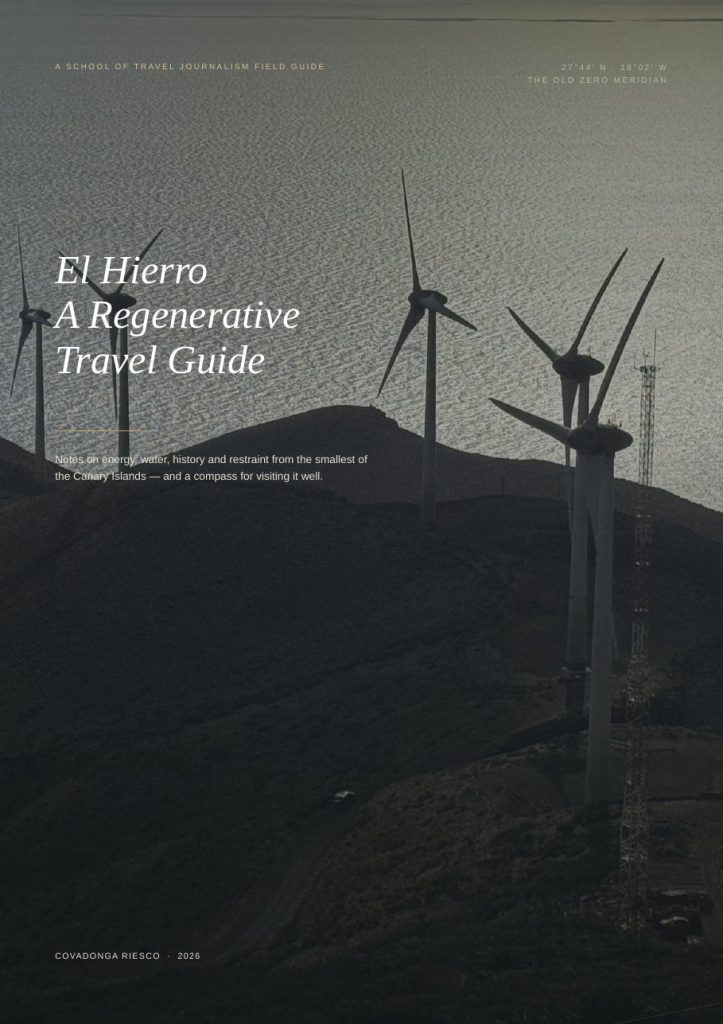
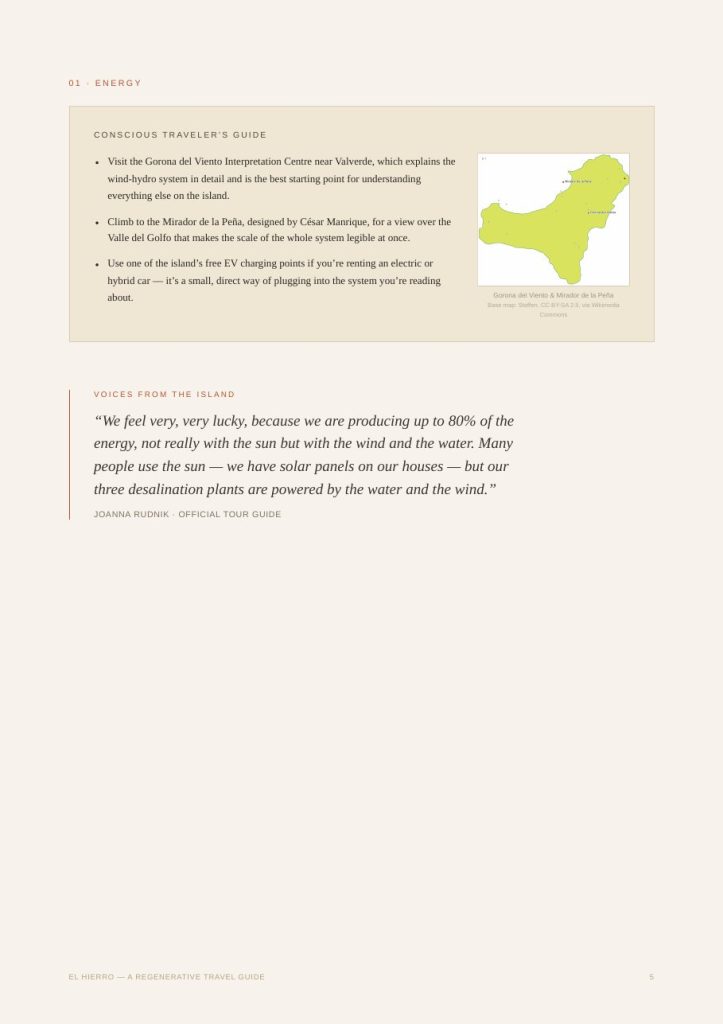
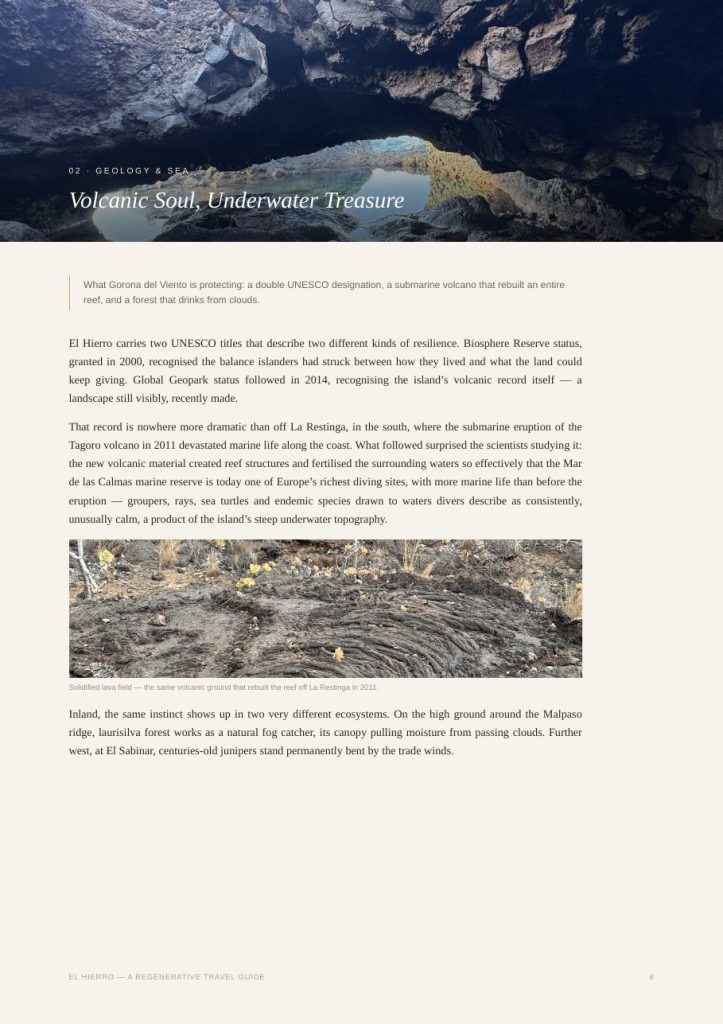
The complete PDF adds seven chapters of context, from Gorona del Viento and the island’s fog-catching water system to the meridian, Valverde, La Bajada and the 3,800-bed legal ceiling that keeps El Hierro small, each with a Conscious Traveler’s Guide, a map and voices from the island. It is free: leave your name and email below and the download link appears straight away.
Planning a trip to El Hierro or elsewhere in Spain? Private Travel Curation designs journeys around the same principles.
More from El Hierro: the full report · the photo essay · the film and podcast
Practical information current as of August 2026.


